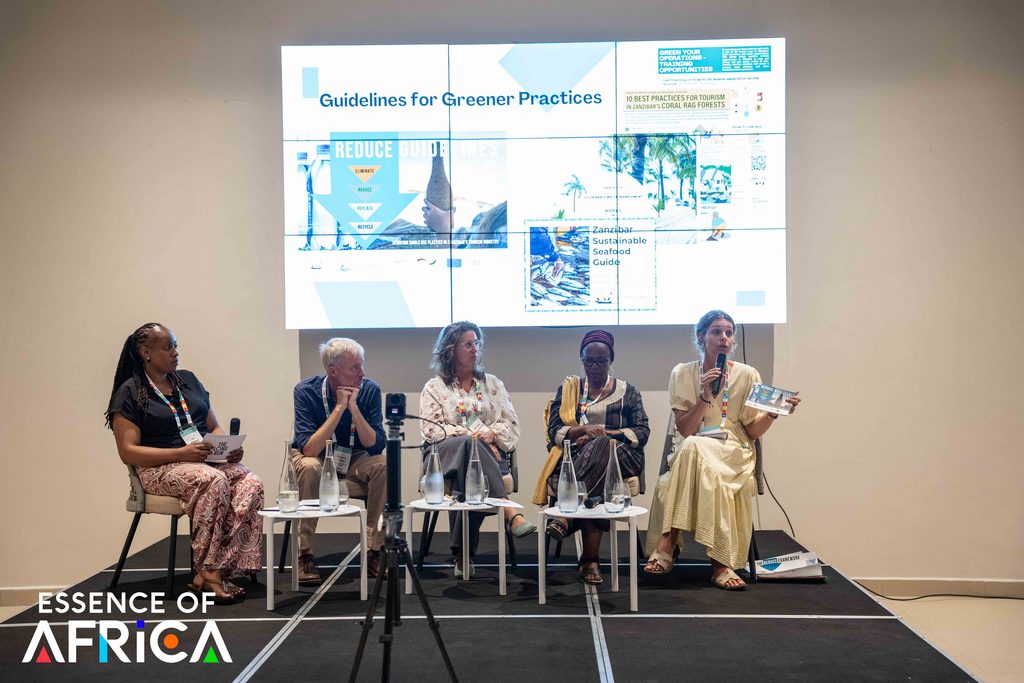
At Essence of Africa 2026, Blue Impact Network introduced new guidelines to help hotels reduce single-use plastics and put Zanzibar’s sustainable tourism commitments into practice.
Every plastic water bottle a visitor uses in Zanzibar has to go somewhere. With limited recycling facilities on the islands, much of that plastic remains long after the visitor has left.
“Literally every single plastic bottle we use or drink from while we’re here in Zanzibar stays in Zanzibar somewhere,” Diana Körner of Blue Impact Network told delegates at Essence of Africa 2026. “If we’re lucky, it lands in the landfill, but most likely somewhere else.”
Körner was speaking during Beyond the Baseline: Zanzibar’s Positive Impact Pioneers, a session moderated by Joy Mbatau, Regional Hub Manager for East Africa at The Long Run, and sponsored by ResRequest. She introduced the recently launched REDUCE Guidelines, developed to help tourism businesses cut down on single-use plastics.

Practical guidance for hotel operations
Developed with support from the European Union and the German government through GIZ, the REDUCE Guidelines give hotels practical advice on reducing plastic waste before it is generated.
For example, properties can replace disposable plastic water bottles with refillable alternatives and work with suppliers to reduce packaging on purchased goods. The guidance is intended to help hotel teams identify changes they can make through their existing operations.
Blue Impact Network also provides access to a sustainable seafood guide developed by Chumbe Island Coral Park, which uses a traffic-light system to help businesses make informed purchasing decisions. Other resources cover hotel waste management.
Getting more hotels involved
Blue Impact Network grew out of work on the Zanzibar Declaration on Sustainable Tourism, launched in 2023. The declaration established five priorities for the destination, including sustainable food production and protection of natural habitats.
Around 200 organisations endorsed it, but Körner said progress in implementing its commitments had been limited. “The real implementation kind of was lacking to some extent,” she told delegates.
The network was established to help government and private businesses put the declaration into practice. However, getting more hotels involved remains difficult.
Körner said the same businesses regularly attend sustainability workshops, despite Zanzibar having more than 900 hotels.
“We do workshops, and then always the same sort of hotels will show up at every workshop,” she said. “But we have more than 900 hotels here on the island. So how do we reach the masses?”
She also described the tendency for public authorities and private operators to blame one another for environmental problems. Blue Impact Network hopes to help both sides work together, recognising their shared interest in protecting Zanzibar as a tourism destination.
The challenge of measuring results
Even hotels already investing in environmental initiatives can struggle to demonstrate what they have achieved.
During the session, delegates were asked what they found hardest about communicating their positive impact. Measuring it was the most common response, selected by 46% of participants.
Körner said a sustainability certification pilot undertaken in Zanzibar the previous year had revealed similar difficulties.
“Many of the hotels that participated in the pilot, although they were already quite engaged in sustainability, didn’t actually have the documentation to prove it,” she said.
Collecting that information required considerable staff time. Hotels therefore need manageable ways to record their environmental activities and results as part of their normal operations.
The information is particularly useful when properties apply for certification or need to substantiate claims made to guests and travel trade partners.
Helping guests understand the island’s challenges
Körner encouraged hotels to explain Zanzibar’s waste challenges to guests who may be accustomed to established recycling systems at home.
Visitors may assume their plastic bottles will be recycled, without realising how limited the island’s facilities are. Hotels can help by explaining the situation and providing reusable alternatives.
Education needs to extend to employees too, so that everyday purchasing and operational decisions take account of waste reduction.
Körner believes the industry also needs to reconsider how it approaches sustainability.
“Unfortunately, sustainability is still a side discussion that we have,” she said, referring to the tendency to address it during dedicated conference sessions rather than as part of routine business decisions.
She questioned whether voluntary commitments would be sufficient to bring about change across Zanzibar’s hotel industry and suggested that some regulatory measures might eventually be necessary.
For hotels looking to get started, the REDUCE Guidelines are available now, providing advice that businesses can apply without waiting for new regulations. For more information, including the REDUCE Guidelines and other resources for Zanzibar’s tourism industry, visit www.blueimpactnetwork.co.tz/resources